Marketing budgets are under more scrutiny than ever. Paid media costs fluctuate, sales cycles are harder to predict, and leadership teams want to know which campaigns actually create revenue. A marketing ROI calculator helps translate marketing activity into financial language, so you can decide where to invest, where to optimize, and where to stop spending.
The goal is not to reduce every marketing decision to one number. Brand awareness, market education, SEO, partnerships, and retention all create value in different ways. The goal is to build a practical decision framework that connects campaign costs, revenue, margins, timelines, and confidence levels.
Used well, a marketing ROI calculator becomes more than a reporting tool. It becomes a smarter budgeting system.
A marketing ROI calculator estimates the return generated from a campaign, channel, or marketing program compared with what you spent to produce it. The basic idea is simple: did the marketing investment create more value than it cost?
The standard formula is:
Marketing ROI = (Revenue attributed to marketing - Marketing cost) / Marketing cost x 100
If you spent $5,000 on a campaign and attributed $20,000 in revenue to it, the simple ROI would be:
($20,000 - $5,000) / $5,000 x 100 = 300%
That looks strong, but it is not the full story. Revenue is not the same as profit. If your gross margin is 50 percent, the campaign produced $10,000 in gross profit before subtracting the marketing cost. A more disciplined formula is:
Marketing ROI = (Attributed revenue x gross margin - Marketing cost) / Marketing cost x 100
Using the same example, the margin-adjusted ROI would be:
($20,000 x 50% - $5,000) / $5,000 x 100 = 100%
Both calculations are useful, but they answer different questions. Revenue-based ROI tells you how much sales activity marketing influenced. Profit-based ROI tells you whether the investment is likely to improve financial performance.
A calculator is only as reliable as the data you put into it. Before you compare campaigns, define the inputs clearly so every channel is evaluated on the same basis.
Important inputs include:
If you skip labor, tools, creative, or sales support, ROI will often look better than it really is. If you use too short an attribution window, long-cycle campaigns such as SEO, webinars, and B2B nurture programs may look worse than they really are.

Do not begin with the formula. Begin with the budget decision.
Are you deciding whether to increase paid search spend? Are you comparing content creation against events? Are you trying to prove that a retention campaign deserves more budget? The answer affects which inputs matter most.
For example, a paid ads campaign may be judged on short-term revenue, customer acquisition cost, and payback period. A content marketing program may need a longer window that includes organic traffic growth, lead quality, assisted conversions, and pipeline influenced.
Many teams only enter ad spend into a marketing ROI calculator. That is a common mistake. A campaign’s real cost includes the resources required to plan, create, launch, manage, and report on it.
For a realistic calculation, include direct costs such as media spend and production, plus indirect costs such as software, contractor time, and internal hours. You do not need perfect precision, but you do need consistency. If one campaign includes labor and another does not, the comparison becomes misleading.
For simple ecommerce campaigns, attributed revenue may be straightforward. A customer clicks an ad, purchases a product, and the transaction is recorded. For B2B, SaaS, finance, legal, and high-consideration services, revenue attribution is more complex.
In those cases, you may calculate ROI using:
The best choice depends on the question. If leadership needs cash-flow visibility, closed-won revenue is safer. If you are planning future budget, pipeline-adjusted revenue can help forecast expected return.
Attribution is where ROI conversations often get messy. Paid search may get the final click, while content, email, social, and webinars influenced the buyer earlier. If your calculator gives all credit to the final touch, you may overfund bottom-of-funnel channels and underfund demand creation.
A simple attribution approach is often enough for budget planning. You might compare first-touch, last-touch, and multi-touch views to see how the story changes. Google’s documentation on attribution in Google Analytics is a useful reference for understanding how different models assign credit.
The key is to decide the rule before you calculate. Changing attribution after seeing results usually creates bias.
Once you have cost, revenue, and margin, calculate both revenue-based ROI and margin-adjusted ROI. This gives you a clearer view of scale and profitability.
For example, imagine a campaign with these numbers:
The revenue-based ROI is:
($24,000 - $10,000) / $10,000 x 100 = 140%
The margin-adjusted ROI is:
($24,000 x 60% - $10,000) / $10,000 x 100 = 44%
This campaign is profitable on a gross-margin basis, but not as dramatically as the revenue-only number suggests. That difference matters when you are deciding whether to scale.
ROI is powerful, but it should not be the only metric in your budget discussion. Add supporting metrics that explain why ROI is high or low.
Useful supporting metrics include customer acquisition cost, cost per lead, lead-to-customer conversion rate, payback period, average deal size, retention rate, and lifetime value. These metrics help you identify whether a campaign needs more spend, better targeting, stronger creative, faster follow-up, or a more efficient funnel.
Suppose your team has $15,000 to allocate next month. You are considering paid search and a webinar campaign.
Paid search has a total projected cost of $15,000. Based on past performance, you expect $45,000 in attributed revenue at a 55 percent gross margin. The margin-adjusted return is $24,750 in gross profit before marketing cost, which produces a 65 percent ROI.
The webinar campaign has a projected cost of $9,000. You expect $26,000 in attributed revenue at a 70 percent gross margin. The margin-adjusted return is $18,200 in gross profit before marketing cost, which produces a 102 percent ROI.
At first glance, paid search creates more revenue. The webinar creates better ROI. The smarter decision depends on your constraint.
If your company needs maximum revenue volume this month, paid search may deserve the larger allocation. If budget efficiency is the priority, the webinar may be the better choice. If sales capacity is limited, the campaign with higher lead quality and higher close probability may win, even if total revenue is lower.
This is where a marketing ROI calculator becomes strategic. It does not just tell you what performed. It helps you understand tradeoffs.
A strong ROI calculation should lead to action. The most useful budget conversations usually fall into four categories.
First, protect proven spend. If a campaign consistently generates profitable return and can still scale, it should not be cut simply because another channel is newer or more exciting.
Second, optimize underperforming spend before eliminating it. Low ROI may come from weak targeting, poor landing pages, slow sales follow-up, unclear offers, or mismatched audiences. The calculator shows the symptom, but you still need to diagnose the cause.
Third, reserve budget for experiments. If every dollar goes to what already works, growth eventually slows. A simple model is to keep most spend in proven channels, allocate a smaller portion to promising tests, and reserve a small amount for higher-risk innovation.
Fourth, compare marginal ROI, not just average ROI. A channel may perform well at $5,000 per month but weaken at $50,000 because the best audience segments are already saturated. Before scaling, estimate what the next dollar is likely to return.
AI marketing tools can make ROI calculations faster and more useful, especially when teams manage multiple channels, campaigns, and reporting systems. AI-powered analytics can help detect performance patterns, summarize campaign results, and surface anomalies that would otherwise be missed.
For example, AI can help marketers review historical campaign performance and identify which audience segments, offers, keywords, or content themes are associated with stronger conversion rates. AI content generation can also speed up the testing process by helping teams create ad variations, landing page drafts, email sequences, and SEO briefs more efficiently.
AI marketing automation is especially useful for workflow consistency. When campaign data, content production, SEO tasks, and reporting live in disconnected systems, budget planning becomes slow and reactive. Marketing workflow automation helps teams move from manual reporting to repeatable decision-making.
However, AI does not remove the need for judgment. It can help forecast outcomes and compare scenarios, but humans still need to define the business goal, validate data quality, choose attribution assumptions, and decide how much risk the budget can tolerate.
Even experienced teams can misuse a marketing ROI calculator. The most common issues are not mathematical. They are strategic.
Watch for these mistakes:
A calculator should make your thinking clearer, not create false certainty. Treat ROI as a decision input, not an absolute truth.
Some marketing investments are difficult to measure in the short term but still essential. Brand awareness, category education, community building, analyst relations, and organic content may influence buyers long before they convert.
That does not mean you should ignore ROI. It means you should pair ROI with leading indicators. For SEO, those indicators may include qualified organic traffic, ranking improvements, assisted conversions, and content-assisted pipeline. For brand campaigns, they may include direct traffic, branded search volume, audience growth, share of voice, and survey-based awareness.
A mature marketing budget includes both performance accountability and patience. If you only fund campaigns that show immediate last-click ROI, you may underinvest in the demand that creates future conversions.
For fast-moving channels such as paid search, paid social, and email promotions, review ROI weekly or monthly. For SEO, content, partnerships, and B2B nurture programs, review leading indicators monthly and ROI quarterly. For brand and market education, use a longer evaluation window and compare trends over time.
The best cadence depends on your sales cycle. A business with a one-day purchase cycle can make budget decisions quickly. A company with a six-month enterprise sales cycle needs patience, pipeline tracking, and better attribution discipline.
The important thing is to review ROI consistently. A calculator used once is a report. A calculator used every planning cycle becomes a budgeting advantage.
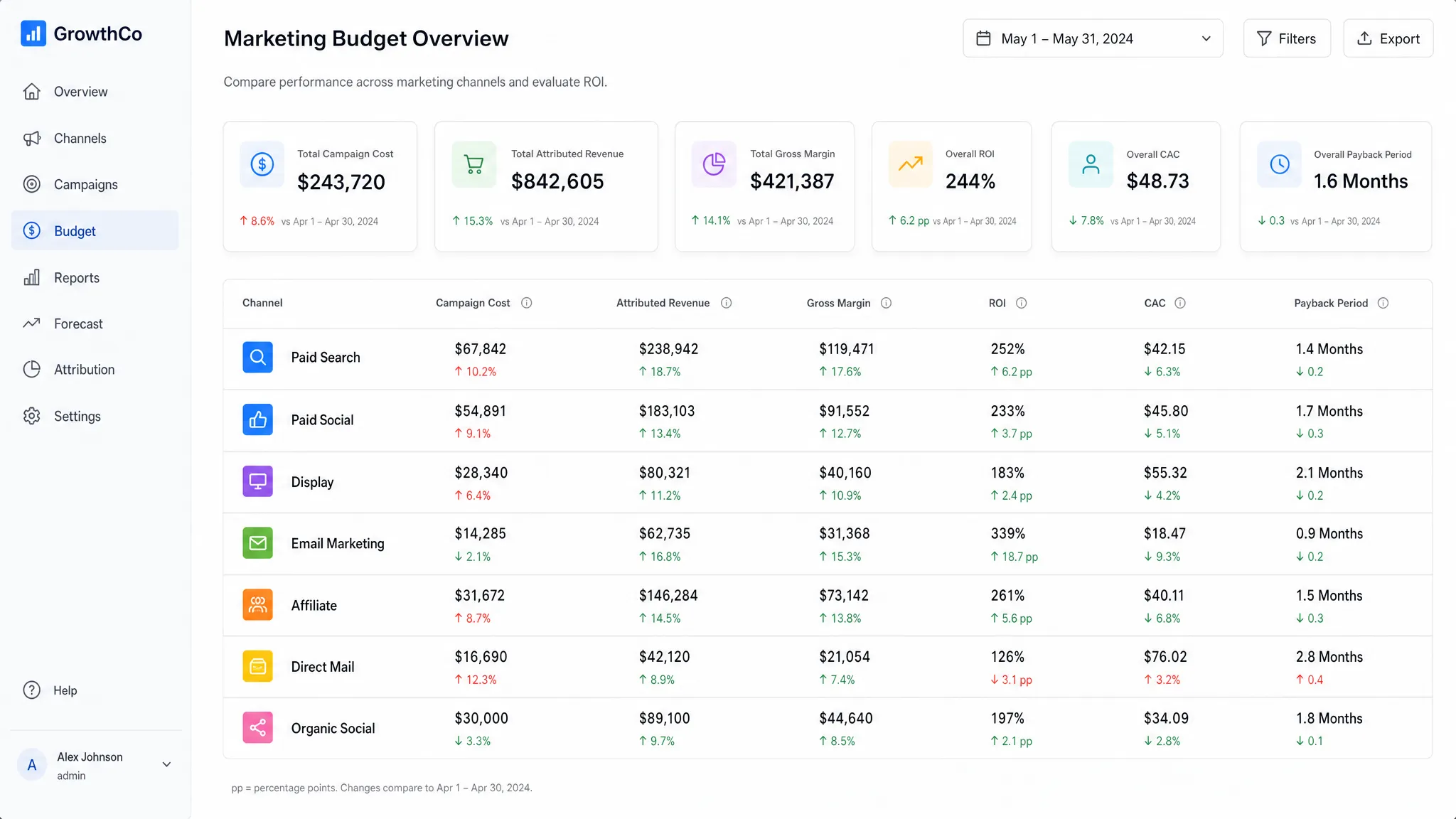
What is a marketing ROI calculator? A marketing ROI calculator is a tool or worksheet that compares marketing-generated revenue or profit against campaign costs. It helps marketers estimate whether a campaign, channel, or program is financially worthwhile.
What is the best formula for marketing ROI? The most useful formula is usually margin-adjusted ROI: attributed revenue multiplied by gross margin, minus marketing cost, divided by marketing cost, then multiplied by 100. This gives a more realistic view than revenue-only ROI.
What is a good marketing ROI? A good marketing ROI depends on your margins, sales cycle, growth goals, and risk tolerance. A campaign with 50 percent ROI may be excellent in a low-risk retention program, while a growth-stage company may accept lower short-term ROI to acquire strategic customers.
Should I use customer lifetime value in my ROI calculation? Use customer lifetime value when repeat purchases, renewals, or subscriptions are central to your business model. For short-term cash planning, also calculate ROI using first-purchase revenue or closed-won revenue.
How often should I update marketing ROI calculations? Update ROI monthly for active performance channels and quarterly for longer-cycle programs such as SEO, content, events, and B2B nurture. Always align the review period with your typical sales cycle.
Can AI tools make ROI calculations more accurate? AI tools can improve speed, pattern detection, forecasting, and reporting consistency. Accuracy still depends on clean data, sound attribution rules, and realistic assumptions about revenue, margin, and conversion rates.
A marketing ROI calculator helps you move from opinion-based budgeting to evidence-based planning. When you include true costs, margin, attribution assumptions, and supporting metrics, you can defend budget decisions with more confidence and make smarter tradeoffs across channels.
If you want practical resources for AI marketing, content creation, SEO, calculators, prompt workflows, and performance planning, explore AIMarketer Hub. It is built to help marketers and businesses automate, optimize, and grow with clearer strategy and better tools.